



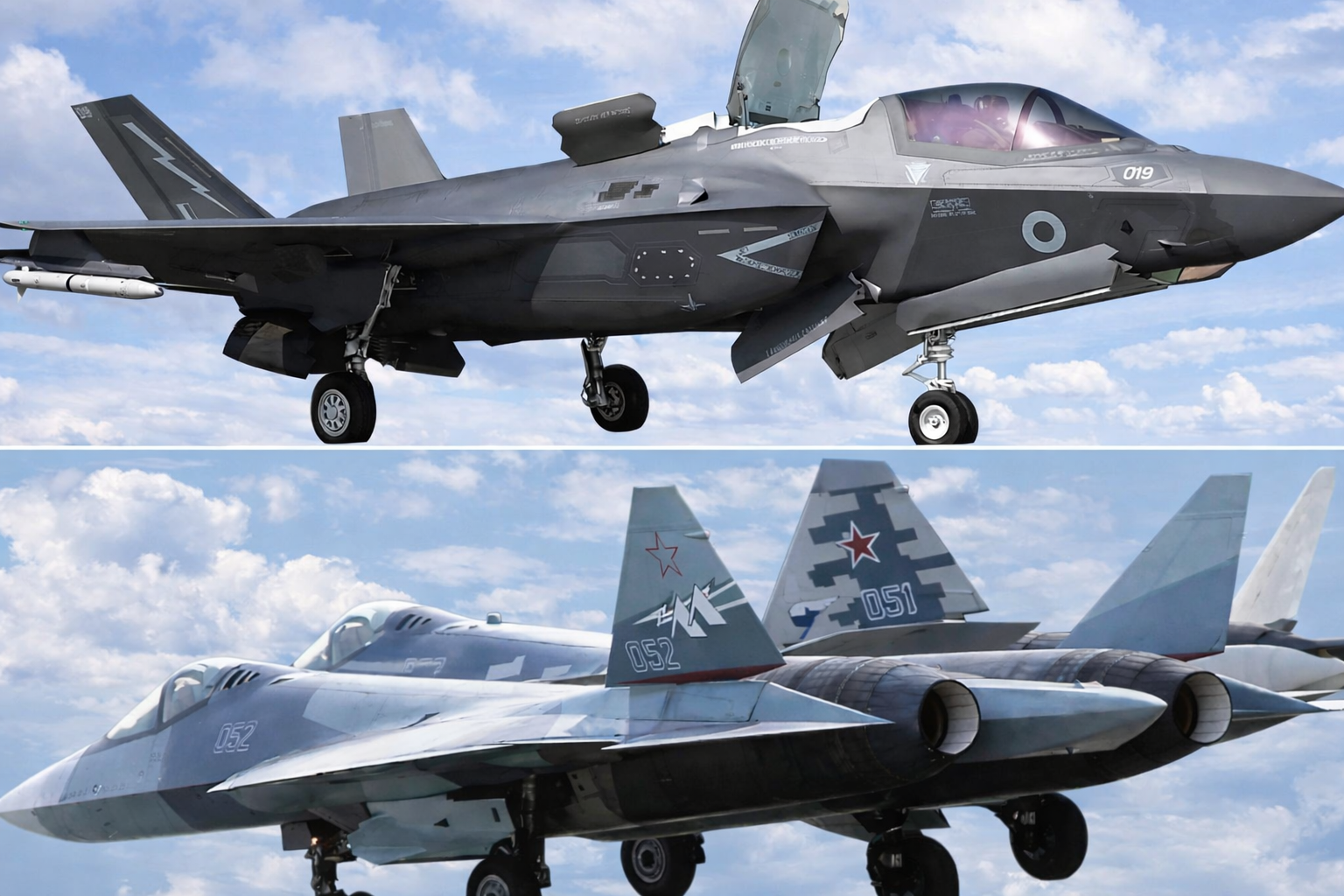
When people search for F-35 vs Su-57, they’re not just comparing two fighter jets. They’re comparing two military ecosystems, two geopolitical power blocs, and two very different philosophies of air dominance.
On one side stands the F-35 Lightning II, America’s multi-role stealth fighter designed for information warfare and global alliance integration. On the other side is Russia’s Su-57 Felon, built around agility, speed, and high-performance air combat.
Both are classified as fifth-generation fighters. Both claim stealth capabilities. Both represent the pinnacle of their respective defense industries.
But which aircraft is actually superior?
The answer depends on what you’re measuring — stealth, dogfighting, sensor fusion, cost, real-world deployment, or strategic influence.
Quick Overview: F-35 vs Su-57 at a Glance
| Feature | F-35 Lightning II | Su-57 Felon |
|---|---|---|
| Country | United States | Russia |
| Generation | 5th Generation | 5th Generation |
| First Flight | 2006 | 2010 |
| Operational Status | Fully operational (multiple countries) | Limited operational deployment |
| Primary Strength | Stealth + Sensor Fusion | Maneuverability + Kinematics |
| Network Integration | Advanced (NATO integrated) | Limited global integration |
This table gives a quick snapshot, but the real story lies deeper.
What Defines a 5th Generation Fighter?
Before diving into F-35 vs Su-57, it’s important to define what “fifth generation” actually means.
A true fifth-generation fighter typically includes:
- Low observable (stealth) design
- Internal weapons bays
- Advanced AESA radar
- Sensor fusion capabilities
- Network-centric warfare integration
- High maneuverability
- Supercruise (sustained supersonic flight without afterburners)
Both aircraft technically qualify. But how they achieve these goals differs significantly.
5th-Generation Fighter Jet Comparison (2026)
| Feature | F-22 Raptor (USA) | F-35 Lightning II (USA/Allies) | Chengdu J-20 (China) | Sukhoi Su-57 (Russia) |
| Primary Role | Air Dominance | Multi-role / Network Hub | Air Superiority / Interceptor | Multi-role / Maneuverability |
| Top Speed | Mach 2.25 | Mach 1.6 | Mach 2.0 – 2.5 | Mach 2.0 – 2.45 |
| Stealth (RCS) | Extremely Low (~0.0001 $m^2$) | Very Low (~0.001 $m^2$) | Moderate to Low (Frontal) | Moderate (~0.1 – 0.5 $m^2$) |
| Supercruise | Yes | No (Limited) | Yes (with WS-15 engines) | Yes (with Izdeliye 30) |
| Combat Radius | ~800 miles | ~670 miles | ~1,240 miles | ~930 miles |
| Internal Payload | 8 Missiles | 4–6 Missiles | 6–8 Missiles | 4–6 Missiles |
| Key Strength | Unmatched Agility & Stealth | Sensor Fusion & Data Links | Long Range & Large Payload | Supermaneuverability |
| Status | Active (180+ Units) | Active (1,000+ Units) | Active (300+ Units) | Active (~20–30 Units) |
Design Philosophy: Information Warfare vs Kinematic Dominance
The most important difference in the F-35 vs Su-57 debate lies in doctrine.
F-35 Philosophy: Win Before the Enemy Knows You’re There
The F-35 was designed around one core principle:
First detect. First shoot. First kill.
The U.S. military doctrine prioritizes information superiority over visual combat. The F-35 is essentially a flying sensor platform capable of gathering, processing, and sharing battlefield data in real time.
The aircraft integrates radar, infrared sensors, electronic warfare tools, and satellite communication into one unified system. The pilot receives a fused digital battlefield picture instead of raw data streams.
The result?
Faster decision-making. Reduced pilot workload. Higher survivability.
Su-57 Philosophy: Outperform and Outmaneuver
Russia’s Su-57 follows a different approach.
Russian air combat doctrine has historically emphasized:
- Extreme maneuverability
- High speed
- Kinematic performance
- Aerodynamic superiority
The Su-57 incorporates thrust-vectoring engines and aerodynamic shaping that enable dramatic high-angle maneuvers.
While it does include advanced avionics, the Su-57’s identity is still rooted in performance dominance rather than network supremacy.
This philosophical divergence shapes the entire F-35 vs Su-57 comparison.
Stealth Comparison: Which Aircraft Is Harder to Detect?
Stealth is often the centerpiece of the F-35 vs Su-57 debate.
F-35 Stealth Design
The F-35 was engineered with stealth as a top priority.
Key features include:
- Internal weapons bays
- Radar-absorbent materials
- Carefully aligned edges and surfaces
- Minimal exposed engine components
- Reduced heat signature management
Its radar cross-section (RCS) is optimized especially from the frontal aspect — the most likely angle during combat engagement.
Most Western defense analysts believe the F-35 has one of the lowest RCS profiles among operational aircraft today.
Su-57 Stealth Design
The Su-57 incorporates stealth features such as:
- Internal weapon compartments
- Composite materials
- Angled surfaces
- Radar-reducing coatings
However, certain structural elements — including engine nozzles and airframe shaping — are believed to generate a larger radar signature compared to the F-35.
Additionally, stealth is not just about airframe geometry — it also involves manufacturing precision and materials technology, where the U.S. has had decades of head start.
Stealth Verdict:
In the pure stealth category within the F-35 vs Su-57 comparison, the F-35 likely has the advantage.
Sensor Fusion and Avionics: The True Battlefield Multiplier
Modern air combat is no longer about turning fights — it’s about seeing first.
F-35 Sensor Suite
The F-35 includes:
- AN/APG-81 AESA radar
- Distributed Aperture System (360-degree IR coverage)
- Electro-Optical Targeting System
- Advanced electronic warfare suite
- Secure data links (Link 16, MADL)
The defining feature is sensor fusion. All systems combine into one coherent interface, presenting the pilot with a unified battlefield view.
The pilot doesn’t need to interpret multiple screens — the aircraft does the integration automatically.
This dramatically reduces cognitive overload during high-pressure combat.
Su-57 Sensor Systems
The Su-57 uses:
- N036 Byelka AESA radar
- Side-looking radar arrays
- Infrared search and track (IRST)
- Electronic countermeasure systems
While advanced, Russia’s sensor integration ecosystem is not globally networked like NATO’s.
The F-35 operates within a massive data-sharing alliance network, which gives it broader situational awareness.
Avionics Verdict:
In the F-35 vs Su-57 comparison, the F-35 likely leads in sensor fusion and network integration.
Maneuverability and Dogfighting: Who Wins Up Close?
If combat reaches visual range, maneuverability matters.
Su-57 Supermaneuverability
The Su-57 features:
- 3D thrust-vectoring engines
- High angle-of-attack stability
- Exceptional roll authority
- Aerodynamic lift-focused design
This makes it capable of extreme post-stall maneuvers.
In a traditional dogfight scenario, the Su-57 likely holds an agility advantage.
F-35 Close-Range Combat
The F-35 was not built primarily as a dogfighter. However, it compensates with:
- Helmet-mounted cueing system
- Advanced short-range missiles
- High off-boresight targeting
Even if less agile, it can lock and fire missiles at angles that earlier fighters could not.
Modern air warfare rarely depends solely on turning performance.
Dogfight Verdict:
In raw agility terms, the Su-57 may outperform the F-35.
Speed, Engines, and Supercruise
Speed still matters — especially in interception roles.
Su-57 Engine Performance
The Su-57 is designed for:
- Supercruise capability
- High thrust output
- Sustained supersonic speed
Its engine configuration supports strong acceleration and climb rates.
F-35 Engine
The F-35 uses the powerful Pratt & Whitney F135 engine, one of the most powerful fighter engines ever built.
However, the F-35 prioritizes:
- Energy management
- Efficiency
- Sensor and power systems
It does not emphasize extreme supercruise in the same way as the Su-57.
Speed Verdict:
The Su-57 likely holds an advantage in kinematic performance within the F-35 vs Su-57 debate.
Weapons and Payload
F-35 Weapons
The F-35 can carry:
- AIM-120 AMRAAM
- AIM-9X Sidewinder
- JDAM precision bombs
- JASSM cruise missiles
- Anti-ship weapons
- Nuclear payload (certain variants)
It can switch between stealth mode (internal carry) and maximum payload mode (external pylons).
Su-57 Weapons
The Su-57 reportedly supports:
- R-77 air-to-air missiles
- R-74 short-range missiles
- Air-to-ground precision weapons
- Hypersonic missile integration (reported capability)
The Su-57 may carry heavier payloads in some configurations.
Weapons Verdict:
Both aircraft are capable multi-role platforms. Effectiveness depends more on doctrine than capacity.
Operational Deployment and Production Scale
This is where the gap becomes significant.
F-35 Production
- Over 1,000 aircraft delivered
- Operated by more than a dozen countries
- Combat-tested in multiple theaters
- Continuous upgrade cycles
The F-35 has become a global standard.
Su-57 Production
- Limited production numbers
- Slower manufacturing rate
- Limited export footprint
Production scale impacts logistics, maintenance, and battlefield redundancy.
Deployment Verdict:
The F-35 leads significantly in operational maturity.
Cost Comparison: Acquisition vs Lifecycle
F-35 Cost
The F-35 program is expensive, but unit costs have declined with scale.
Lifecycle cost remains high due to maintenance complexity.
However, the global supply chain offsets operational risk.
Su-57 Cost
Reportedly lower acquisition cost.
However, smaller ecosystem means limited shared maintenance infrastructure.
Cost must be evaluated beyond sticker price.
Electronic Warfare Capabilities
Electronic warfare (EW) is critical in modern combat.
The F-35 integrates advanced EW capabilities capable of:
- Jamming enemy radar
- Disrupting communications
- Gathering electronic intelligence
The Su-57 also includes electronic countermeasure systems, but public data on integration depth is limited.
In the EW domain, the F-35 likely benefits from larger research investment.
Combat Experience
| Feature | F-35 Lightning II (USA & Allies) | Su-57 Felon (Russia) |
| First Combat Use | 2018 (Israel vs. Iranian targets in Syria) | 2018 (Russia vs. targets in Syria) |
| Major Theaters | Syria, Iraq, Afghanistan, Iran, Yemen. | Syria, Ukraine. |
| Primary Mission Type | SEAD/DEAD (Suppression/Destruction of Air Defenses), precision deep strikes, and CAS. | Standoff precision strikes, air defense suppression, and evaluation of new weapons. |
| Key Combat Successes | Successfully neutralized Iranian S-300 SAM sites (Oct 2024); performed deep penetration of Iranian airspace (Operation Midnight Hammer, June 2025). | Successful use of X-69 stealth cruise missiles in Ukraine (2024–2025); reported evasion of NATO-integrated radar systems. |
| Unique Achievements | “First In, Last Out”: Acted as a sensor hub to guide bombers and non-stealth jets during strikes on heavily defended sites. | Unmanned Integration: First 5th-gen jet to actively control an unmanned wingman (S-70 Okhotnik) in a combat zone. |
| Operational Losses | None to enemy fire; several training/carrier mishap losses (e.g., HMS Queen Elizabeth, USS Carl Vinson). | No confirmed combat losses; one serial production aircraft crashed during factory trials in 2019. |
| Scale of Deployment | High: Hundreds of sorties flown by US, UK, and Israel; thousands of flight hours in combat. | Very Low: Typically deployed in pairs or small links (4 jets) to test systems rather than maintain constant presence. |
Detailed Guide to Their Outcomes
The F-35: The Proven “Quarterback”
The F-35’s combat outcomes have solidified its reputation as the world’s premier electronic warfare and sensor platform. Its success isn’t just measured in bombs dropped, but in its ability to operate in “A2/AD” (Anti-Access/Area Denial) environments.
-
Outcome: In 2025 and early 2026 operations over Iran, the F-35 demonstrated that it could effectively “blind” Russian-made S-300 and S-400 radar systems, allowing older F-15s and F-16s to operate safely.
The Su-57: The “Standoff Sniper”
The Su-57’s history is defined by cautious but highly technical deployment. Russia avoids using the “Felon” for close-in dogfights, instead utilizing it as a platform for launching long-range, high-precision missiles from safe distances within friendly airspace.
-
Outcome: Its deployment in Ukraine (2022–2026) has primarily been used to validate its X-69 cruise missiles and R-37M long-range air-to-air missiles. While it has successfully evaded detection, its low production numbers mean it cannot yet change the overall course of a large-scale war.
Comparative Summary
-
The F-35 is a matured system used for daily deterrence and offensive operations across the Middle East.
-
The Su-57 is a testing platform used to demonstrate technological parity with the West, though it remains a “boutique” fighter due to industrial constraints.
Strategic Implications: NATO vs Russia
The F-35 vs Su-57 debate is geopolitical.
The F-35 integrates multiple allied nations into one air warfare ecosystem.
The Su-57 represents strategic independence within Russia’s defense model.
In a NATO-led environment, the F-35 thrives.
In a controlled Russian air defense ecosystem, the Su-57 may perform differently.
Context defines advantage.
Which Is Better: F-35 vs Su-57?
There is no universal winner.
Choose F-35 if priority is:
- Stealth dominance
- Network warfare
- Sensor fusion
- Global interoperability
Choose Su-57 if priority is:
- Extreme maneuverability
- Supercruise performance
- Aerodynamic dominance
Modern warfare increasingly favors information superiority over raw maneuvering.
In that context, the F-35 aligns more closely with evolving air combat doctrine.
Final Thoughts on F-35 vs Su-57
The F-35 vs Su-57 comparison is not about which aircraft looks more powerful at an airshow.
It is about:
- Doctrine
- Ecosystem
- Strategic integration
- Industrial capacity
- Long-term sustainability
The F-35 represents coalition warfare and digital battlefield dominance.
The Su-57 reflects performance-focused independence and aerodynamic strength.
Both aircraft symbolize national ambition.
Both push aerospace engineering boundaries.
But in modern conflict, the aircraft that sees first and shares faster often survives longer.
And that may ultimately decide the future of air dominance.