



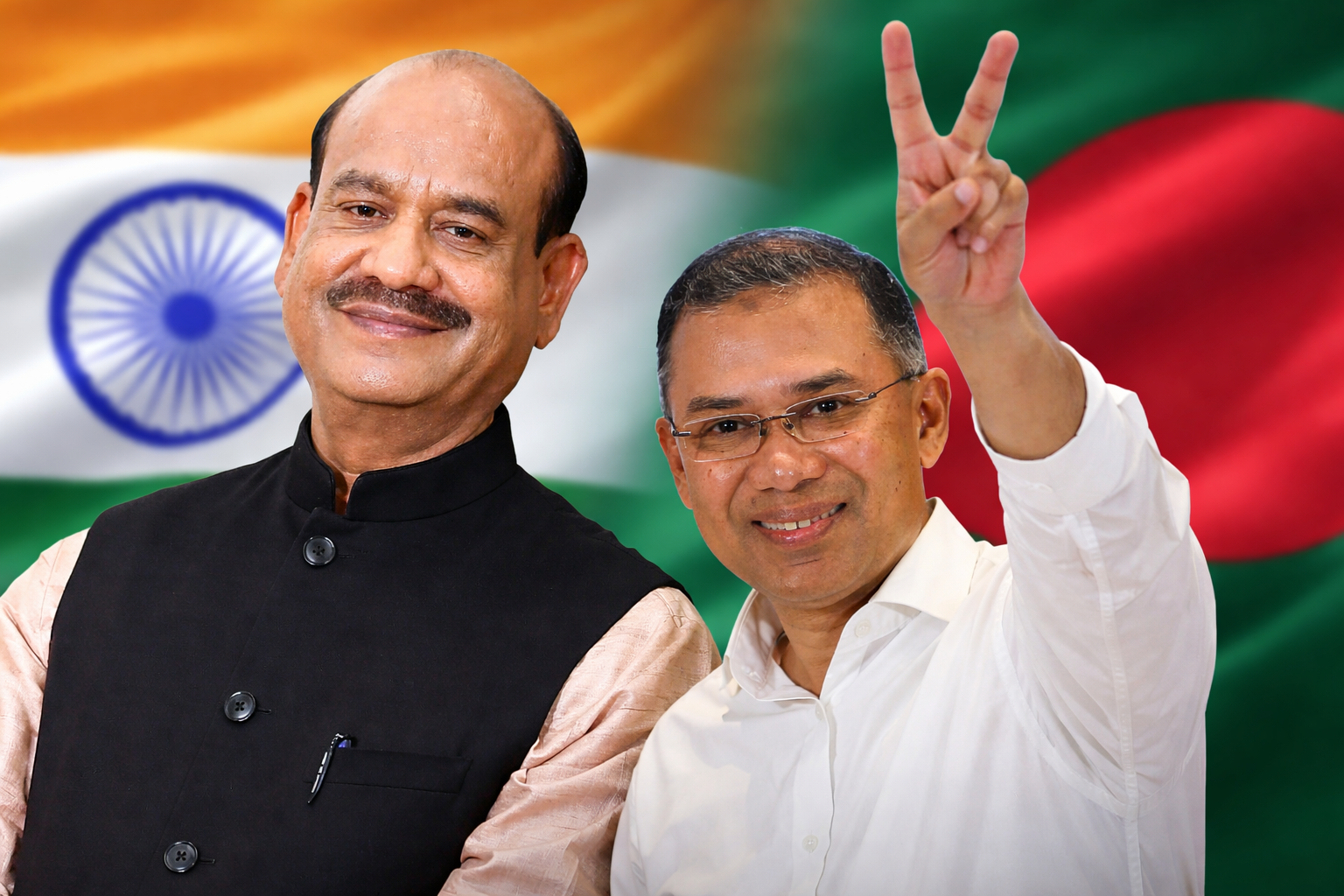
The geopolitical landscape of South Asia is undergoing its most profound transformation in nearly two decades.
On Tuesday, February 17, 2026, the South Plaza of the Jatiya Sangsad (National Parliament) will host a ceremony that many in Dhaka are calling “The New Dawn.” As Tarique Rahman, the Chairman of the Bangladesh Nationalist Party (BNP), prepares to take the oath as Prime Minister, New Delhi is signaling its readiness for a “total reset” of its own.
In a move of significant diplomatic weight, the Government of India confirmed today that Lok Sabha Speaker Om Birla will lead the Indian delegation to Dhaka.
Accompanied by Foreign Secretary Vikram Misri, Birla’s presence represents more than just neighborly protocol; it is an olive branch extended to a party that was once considered New Delhi’s most formidable antagonist in the region.
The Mandate: A Return from the Wilderness
The election results of February 12, 2026, were nothing short of a political earthquake. The BNP, along with its alliance partners, secured a crushing majority of 209 seats in the 297-member parliament. For Tarique Rahman, this victory is the culmination of 17 years in self-imposed exile in London and a year-long “restoration narrative” that began upon his return to Bangladesh in late 2025.
Rahman’s rise effectively closes the 15-year chapter of the Awami League under Sheikh Hasina, whose departure following the August 2024 uprising left a power vacuum that an interim government led by Muhammad Yunus struggled to fill. Today, the “Bangladesh First” agenda has triumphed, and the world is watching how the “heir to the dynasty” will govern a nation hungry for economic stability and democratic reform.
The Indian Strategy: Why Om Birla?
The choice of Om Birla as India’s representative is a masterclass in “Democracy Diplomacy.” While Prime Minister Narendra Modi’s absence is necessitated by a high-stakes bilateral summit with French President Emmanuel Macron and the India-AI Impact Summit, sending the Speaker of the Lok Sabha carries a distinct message.
By sending the custodian of India’s parliament, New Delhi is acknowledging the legitimacy of the BNP’s democratic mandate. It is a subtle shift from the “G2G” (Government-to-Government) focus of the Hasina years to a “P2P” (Parliament-to-Parliament) and “People-to-People” approach. The Ministry of External Affairs (MEA) noted that this participation “reaffirms India’s steadfast commitment to the democratic values that bind our two nations.”
The “Total Reset”: Navigating the New Terms of Engagement
The phrase “total reset” has become the mantra of the incoming administration. Humayun Kabir, a senior advisor to Rahman, has been vocal about the need for India to recognize the “changed political reality.” The reset, as envisioned by Dhaka, rests on three critical pillars:
1. Sovereignty and “Mutual Respect”
Tarique Rahman has adopted a “Friend Yes, Master No” stance. In his first post-victory interaction, he emphasized that foreign policy would be guided strictly by Bangladesh’s national interests. For India, this means moving away from the perception of being the sole guarantor of a specific regime and instead building a broad-based relationship that respects the BNP’s desire for a “balanced” foreign policy—one that includes robust ties with China, Pakistan, and the Middle East.
2. The “Extradition Question”
Perhaps the most sensitive issue on the table is the presence of former PM Sheikh Hasina in India. The BNP leadership faces immense domestic pressure—particularly from its alliance partner, Jamaat-e-Islami (which secured 68 seats)—to seek her extradition to face the International Crimes Tribunal (ICT). How New Delhi handles this “politically sensitive guest” will be the first major litmus test for the new bilateral era.
3. Security and Minority Protection
New Delhi remains wary of a return to the security environment of the early 2000s, when anti-India insurgent groups reportedly found safe haven in Bangladesh. However, in a conciliatory move, Rahman has spent the last year moderating his rhetoric, emphasizing communal harmony and ensuring that “no one is a minority” in his vision of a united Bangladesh.
Economic Interdependence: The Stabilizing Force
Despite the political shifts, the economic reality remains a powerful tether. Bangladesh is India’s largest trading partner in South Asia. From textile supply chains to energy grids, the two nations are deeply integrated.
The Energy Link: Bangladesh currently relies on power imports from India to sustain its industrial growth.
The Transit Corridor: India’s access to its Northeastern states through Bangladeshi territory remains a strategic priority.
Rahman’s focus on “economic security” suggests that he is unlikely to disrupt these vital links, provided they are framed as “win-win” partnerships rather than concessions.
The Geopolitical Chessboard
Dhaka’s guest list for the swearing-in ceremony—which includes representatives from 13 nations including China, Pakistan, Saudi Arabia, and Turkey—highlights Rahman’s intent to diversify his country’s strategic portfolio. While the interim government under Muhammad Yunus was perceived as warming up to Islamabad and Beijing, Rahman’s BNP is signaling a more nuanced “balanced” approach.
For India, the goal is clear: prevent a strategic drift that would see Bangladesh fall entirely into a rival’s orbit, while simultaneously protecting the 4,000 km shared border.
Final Outlook
As Om Birla lands in Dhaka, he carries the weight of a complex history and the hope for a pragmatic future. The “total reset” is not just a demand from Dhaka; it is a necessity for New Delhi. If the two neighbors can navigate the transition with “mutual respect and fairness,” the 2026 election could mark the beginning of a more mature, stable, and less personality-driven partnership.
Analyst Note: “The return of the BNP is not a threat to India, but an invitation to diversify its diplomatic assets. The era of putting all eggs in one basket is over.”